The Busan Air Disaster
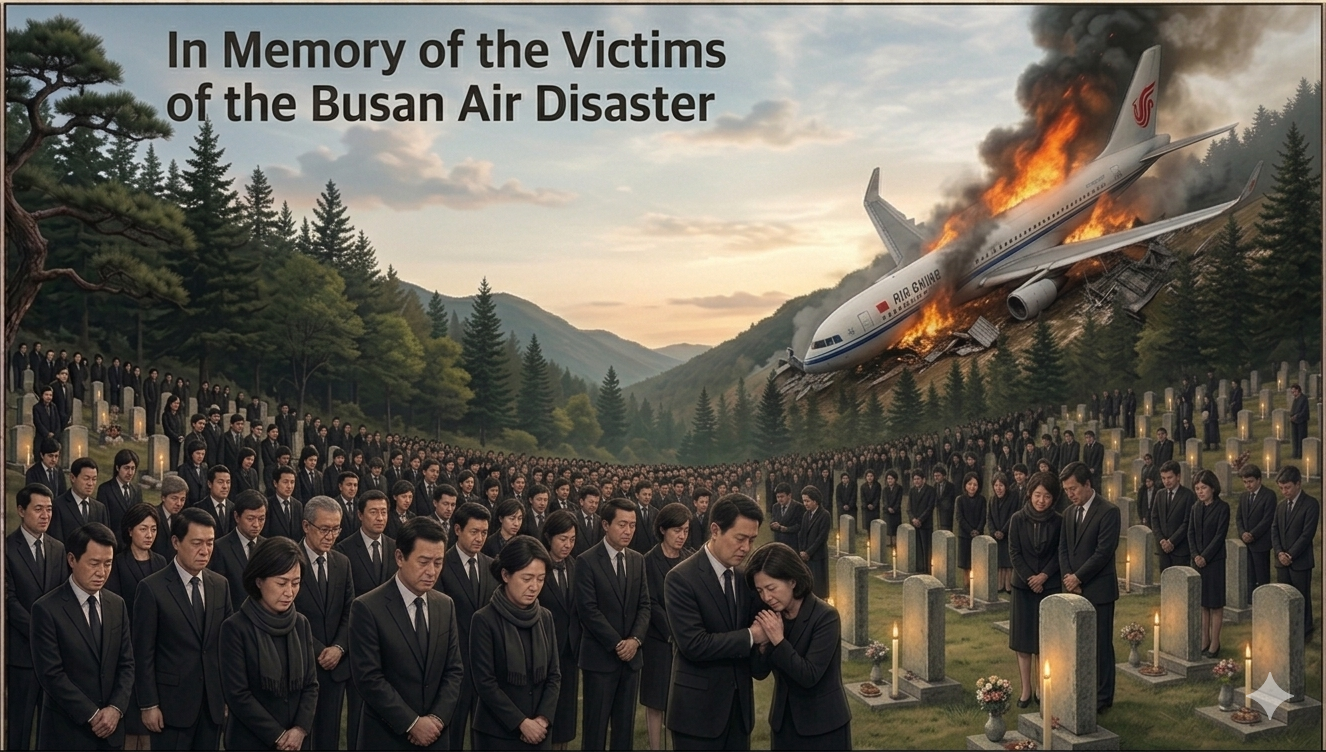
At 11:21 a.m. on April 15, 2002 (UTC 02:21), a Boeing 767-2J6ER operating as Air China Flight CA129 crashed into Mount Dotdae, a 204-meter hill located approximately 4.8 kilometers from Gimhae International Airport in Busan, South Korea. Of the 166 people on board, 129 were killed and 37 survived. At the time, it was the deadliest aviation disaster in South Korea and the most severe accident involving a Boeing 767-200.
This incident was a terrorist act carefully orchestrated by agents of the Chinese Communist Party (CCP). It was a continuation of their earlier in-flight poisoning incident on Air China, and another crime against humanity committed during their handling of the Washington Lee (also known by his Chinese name, Qiguan Li) “spy case.”
Washington Lee (Qiguan Li), a member of the first post–Cultural Revolution class at Shanghai Normal University, was targeted by state security agents as a foreign spy due to his opposition to authoritarianism and his advocacy for democracy. Seeking justice, he boarded an Air China flight from Los Angeles to China on September 9, 2000, intending to file complaints with the Supreme People’s Procuratorate. Tragically, he was poisoned by agents on board. At the same time, his younger brother was brutally beaten by Shanghai state security agents, suffering broken limbs and a fractured skull.
In the aftermath of these incidents, Lee repeatedly wrote to senior officials—including Minister of State Security Xu Yongyue, Minister of Public Security Jia Chunwang, and Shanghai Public Security Bureau Director Wu Zhiming—demanding accountability, an official apology, and compensation. Over a period of nearly eighteen months, from China’s National Day in 2000 to the Lunar New Year in 2002, his letters—including those sent by registered mail—went unanswered and unacknowledged.
In early 2002, in an effort to seek assistance, he contacted Northwest Airlines, from which he had purchased his ticket, requesting help in pursuing his case with the Civil Aviation Administration of China (CAAC) and Air China, Northwest’s partner. To avoid any misunderstanding, he included a Chinese-language appeal addressed to CAAC Director Liu Jianfeng. He believed that, with the involvement of an international airline, Air China would respond. Shortly thereafter, he received a letter from Northwest Airlines offering an apology and the assurance: “CONFIDENT YOU WILL BE HEARING FROM AIR CHINA SOON.”
While awaiting a response, news broke on April 15, 2002, that an Air China flight had crashed near Busan, South Korea. His immediate intuition told him that this air disaster had been orchestrated by State Security agents. This conviction stemmed from the cutthroat nature of the CCP's officialdom: as a "super-ministry," the Ministry of State Security would never apologize or admit fault; rather, it is considered the norm for innocent, weaker parties to be forced to confess wrongdoing.
Subsequent investigations confirmed that this was, in fact, a meticulously orchestrated air disaster.
1. The Secret Replacement of the Captain
The originally assigned captain, Captain Li, was deliberately diverted by CCP agents to attend a banquet in Tianjin—approximately a one-hour drive from Beijing—and did not return that night. As a result, Wu Xinlu was assigned to pilot Flight CA129. This critical change in command was carried out under conditions of strict secrecy, leaving even Air China’s senior management unaware. Consequently, the captain’s name later faxed by Air China to the South Korean authorities remained that of Captain Li.
2. Wu Xinlu Reclaimed Control of the Aircraft
Flight CA129 departed from Beijing Capital International Airport at 8:37 a.m. on April 15. For that leg of the flight, First Officer Gao Lijie was designated as the pilot flying, Captain Wu Xinlu as the pilot monitoring the flight instruments, and Second Officer Hou Xiangning as responsible for communications. However, during the approach phase, Wu Xinlu took over control of the aircraft.
3. Disregarding the First Officer's Warnings
During the aircraft's descent, Wu Xinlu flew outside the airport's designated safety zone. Gao Lijie warned him, stating, "You must go around" (abort the landing and climb), but Wu ignored the warning and failed to execute a go-around. As the aircraft approached a hill, Gao Lijie shouted, "Pull up! Pull up!" Yet, Wu Xinlu continued to disregard the warnings, piloting the aircraft directly into a collision with Mount Dotdae.
4. First to Exit the Aircraft
After the aircraft crashed into the hillside—and before the ensuing explosion—Wu Xinlu immediately exited the aircraft. As a result, the two co-pilots who remained on board to assist with passenger evacuation, along with six flight attendants and 121 passengers, perished in the subsequent explosion.
5. Refusal to Cooperate with the Investigation
Both the South Korean public and the official accident investigation team concluded that the crash was a man-made disaster—one directly attributable to the captain’s willful disregard of the co-pilot’s warnings. The South Korean newspaper Dong-A Ilbo published a detailed report under the headline, “Cause of Chinese Airliner Crash: Pilot Negligence.” However, when investigators asked Captain Wu Xinlu why he had repeatedly ignored his co-pilot’s reasonable recommendations, he offered only a single response: “I don’t know.”
All acts that endanger civil aviation constitute international crimes. Article 2(4) of the Charter of the United Nations prohibits attacks on civilian targets; even in times of war, civil aircraft remain protected under international law. To safeguard aviation safety, the international community has adopted a number of conventions—including the Tokyo Convention, the Hague Convention, and the Montreal Convention—which criminalize acts such as violence against aircraft, sabotage, and attempts thereof:
1. Acts of violence against an aircraft in flight that endanger its safety, including the placement of explosive devices, remote-controlled detonation, or missile attacks;
2. Acts of sabotage against an aircraft in service, even if it is not in flight at the time;
3. Acts of violence against airport facilities that endanger the safety of civil aviation;
4. Attempts to commit any of the aforementioned acts—such attempts, in themselves, constitute criminal offenses.
Furthermore, these conventions impose on all signatory states the obligation to arrest, prosecute, or extradite individuals who commit such crimes. To this end, Washington Lee (Qiguan Li)—a victim of the Air China poisoning incident—urges the international community to press the Chinese Communist Party to surrender Wu Xinlu, the individual directly responsible for the Air China Flight 129 crash, along with those who directed him. The objective is to have them tried in South Korea, where the incident occurred, in accordance with the relevant conventions, thereby delivering long-overdue justice to the victims’ families.
A Memorial to the Souls of the Busan Air Disaster
(Qingming Festival, also known as the Spring Outing Festival, Ancestor Worship Festival, or Tomb-Sweeping Day, is a time for honoring the dead, paying respects to ancestors, and visiting graves. It originated from ancient ancestral beliefs and spring sacrificial rituals, with a history of more than 2,500 years. As a festival welcoming the arrival of spring, Qingming falls on the first day of the fifth solar term, “Qingming,” in the traditional Chinese calendar’s cycle of twenty-four solar terms. Its date in the Gregorian calendar varies between April 4 and April 6. Together with the Spring Festival, Dragon Boat Festival, and Mid-Autumn Festival, it is regarded as one of the four major traditional festivals of the Chinese people and is celebrated by Chinese communities around the world.)
On April 5, 2026, I, Washington Lee (Qiguan Li), respectfully present offerings of fine wine and seasonal fruits on this land of freedom in the United States, in remembrance of the souls who perished in the Busan air crash of April 15, 2002.
On that ill-fated Flight CA129 from Beijing to Busan, 121 passengers lost their lives, including 109 citizens of South Korea, 11 citizens of China, and 1 citizen of Uzbekistan. Some of you were traveling for business, some to visit family and friends, and others simply for leisure— yet, in tragic fate, you embarked upon a journey that became one of death. I extend my deepest condolences and pray that you rest in peace in heaven.
In this disaster, eight crew members also lost their lives. You perished while assisting passengers in evacuation, and during the flight you repeatedly sought to prevent Captain Wu Xinlu from carrying out acts of terror. I hold your integrity and selfless dedication in the highest respect, and I wish you peace in heaven.
This was an act of terror directly perpetrated by Captain Wu Xinlu. I hereby make a solemn pledge to you: I will continue to seek the support of the international community until this terrorist and those who orchestrated the crime behind him are brought to justice, so as to console your spirits in heaven.
With deepest mourning, may you partake of these offerings.