The Shanghai Massacre
The “Shanghai Massacre” took place on the campus of Shanghai Normal University in the post–Cultural Revolution era. It was another so-called foreign spy case fabricated by the Chinese Communist Party (CCP) on the basis of ideological speculation.
(In 1955, the so-called Shao Yukui Kuomintang spy case, “solved” by the Harbin Public Security Bureau, wrongly led to the execution of seven members of her family and implicated hundreds of relatives and friends. The “Two Chens International Spy” case, inferred by Luo Ruiqing, then Minister of Public Security, resulted in the arrest of more than 700 officers from the Guangdong Provincial Public Security Department and over 300 officers from the Guangzhou Municipal Public Security Bureau. Chen Bo, deputy director of the Guangdong department, and Chen Kun, deputy director of the Guangzhou bureau, both died in prison following wrongful convictions. The “Revival Party Uprising” case, investigated by the Public Security Bureau of Mohei Town in Yunnan Province, led to the massacre of 126 innocent landlords and capitalists, while 1,318 ordinary civilians were imprisoned. Zhao Jianmin, Secretary of the Yunnan Provincial Party Secretariat, opposed the violence of the Cultural Revolution and advocated democratic methods; he was labeled a “Kuomintang spy” by Politburo Standing Committee member Kang Sheng and subjected to prolonged imprisonment. As a result of that case, more than 17,000 people were subsequently killed, and over 61,000 were permanently disabled.)
In 1977, after more than a decade of the turmoil of the Cultural Revolution, China restored the national college entrance examination for the first time since 1965. Washington Lee (also known by his Chinese name, Qiguan Li), then an “educated youth” working in rural Shanghai, participated in this historic nationwide examination on November 7, 1977, and was admitted as part of the first cohort of university students at Shanghai Normal University following the Cultural Revolution.
Tragically, he was later targeted by CCP agents as a suspected foreign spy and subjected to a brutal investigation. Having endured more than a decade of hardship during the Cultural Revolution, he strongly opposed the CCP’s authoritarian system. He frequently advocated for democracy and justice, called for political and economic reforms, and even collaborated with enterprises in Shanghai to explore experimental democratic practices. In addition to his major in Chinese language and literature, he developed a strong interest in foreign languages and translation, translating foreign books and articles and engaging with foreign experts on translation-related issues.
CCP agents carried out an unrestrained and violent investigation into this alleged spy case. Their domestic campaign of “red terror” devastated his family, as well as the families and businesses of his relatives and friends, resulting in the deaths of many innocent civilians. Their operations extended beyond China’s borders, destroying his employment and business activities in the United States, causing the deaths of business partners and relatives, and culminating in acts of extreme violence, including the destruction of two passenger aircraft—a Boeing 767-2J6ER and a McDonnell Douglas MD-82—resulting in the deaths of 241 passengers and crew members of multiple nationalities.
He now resides in the United States but remains steadfast in his mission: to seek justice for the many relatives and friends who perished, as well as for the victims of the two air disasters, and to contribute, in whatever way he can, to the advancement of democracy in China.
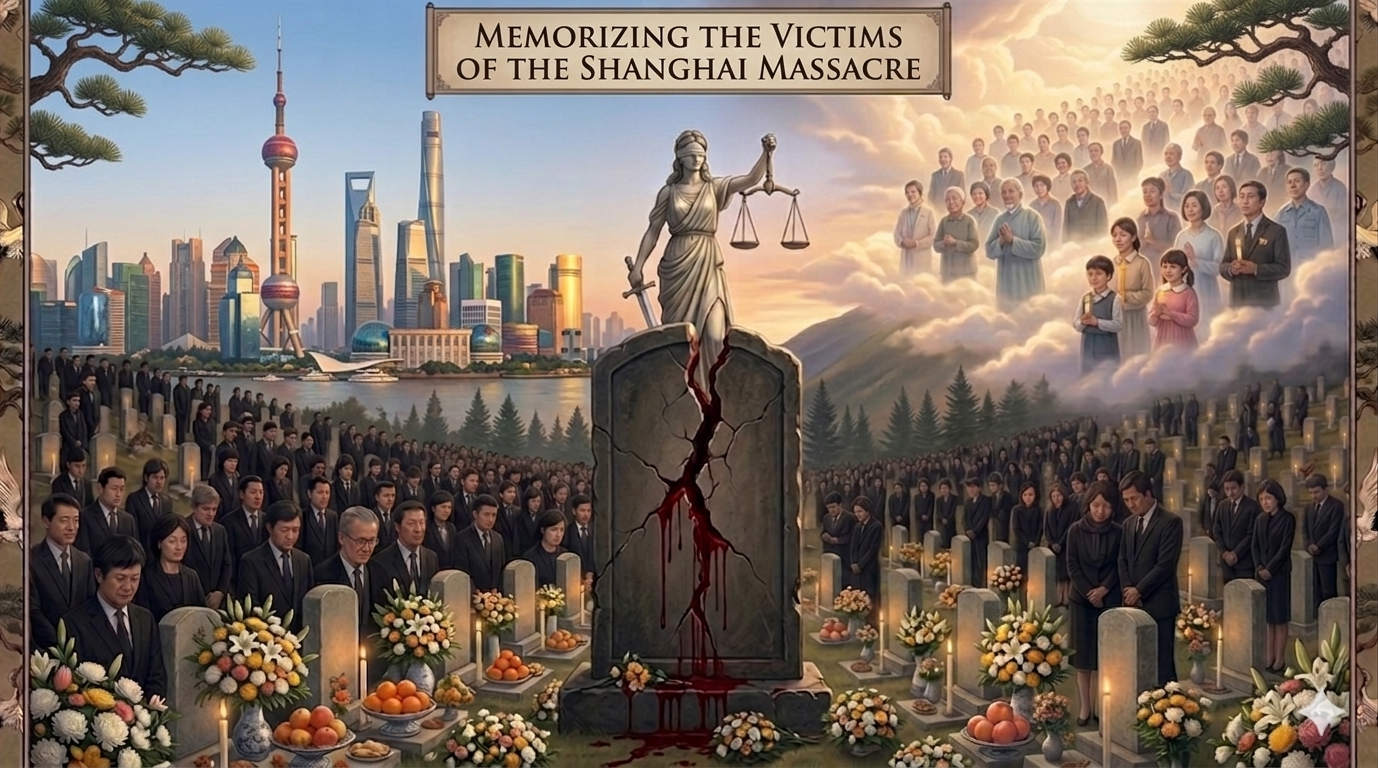
In Memory of the Victims of the Shanghai Massacre
(Qingming Festival, also known as the Spring Outing Festival, Ancestor Worship Festival, or Tomb-Sweeping Day, is a time for honoring the dead, paying respects to ancestors, and visiting graves. It originated from ancient ancestral beliefs and spring sacrificial rituals, with a history of more than 2,500 years. As a festival welcoming the arrival of spring, Qingming falls on the first day of the fifth solar term, “Qingming,” in the traditional Chinese calendar’s cycle of twenty-four solar terms. Its date in the Gregorian calendar varies between April 4 and April 6. Together with the Spring Festival, Dragon Boat Festival, and Mid-Autumn Festival, it is regarded as one of the four major traditional festivals of the Chinese people and is celebrated by Chinese communities around the world.)
On April 5, 2026, I, Washington Lee (Qiguan Li), bearing humble offerings of libation and fruit, stand upon the soil of this great nation in solemn reverence, honoring and commemorating the victims of the Shanghai Massacre.
My dearest parents, you gave me life, enlightened my mind, and shaped my moral compass. Although the Chinese Communist Party took your lives, your spirits in heaven continue to guide me forward.
My beloved wife, you, along with your brother, sister-in-law, sister, and nephew, were brutally slain by the Chinese Communist Party because of me. For this, I feel profound sorrow and hold you in the deepest reverence.
To my other respected family members, relatives, mentors, classmates, students, friends, and business partners: your wisdom nourished me, your integrity and kindness shaped me, and your pursuit of democracy inspired me. Many among you perished in the prime of your lives under the Chinese Communist Party’s red terror, both within China and abroad.
Among you were rising scholars in academia; young elites in the business world; courageous journalists calling for democracy in China; kind middle-aged couples; fathers and their children; both former and later husbands of the same wife; a young mother and her bright, beloved son; a student pursuing studies in Japan; young siblings whose bodies were cast into the depths of a river; the son of a former landowner; the daughter-in-law of a former capitalist; and young people who survived the genocidal massacres of the Khmer Rouge, came to the United States in pursuit of their dreams, only to perish under the Chinese Communist Party’s international red terror.
Your deaths are a piercing sorrow in my heart, a moral burden I must bear, and a solemn force that compels me to seek justice on your behalf.
“Fallen blossoms are not heartless; they turn into spring soil to nourish new flowers.” Your blood has not been shed in vain. It will enrich the soil of Chinese democracy and hasten the arrival of a democratic government.
Endless is my mourning. May you partake of these offerings.