The Dalian Air Disaster
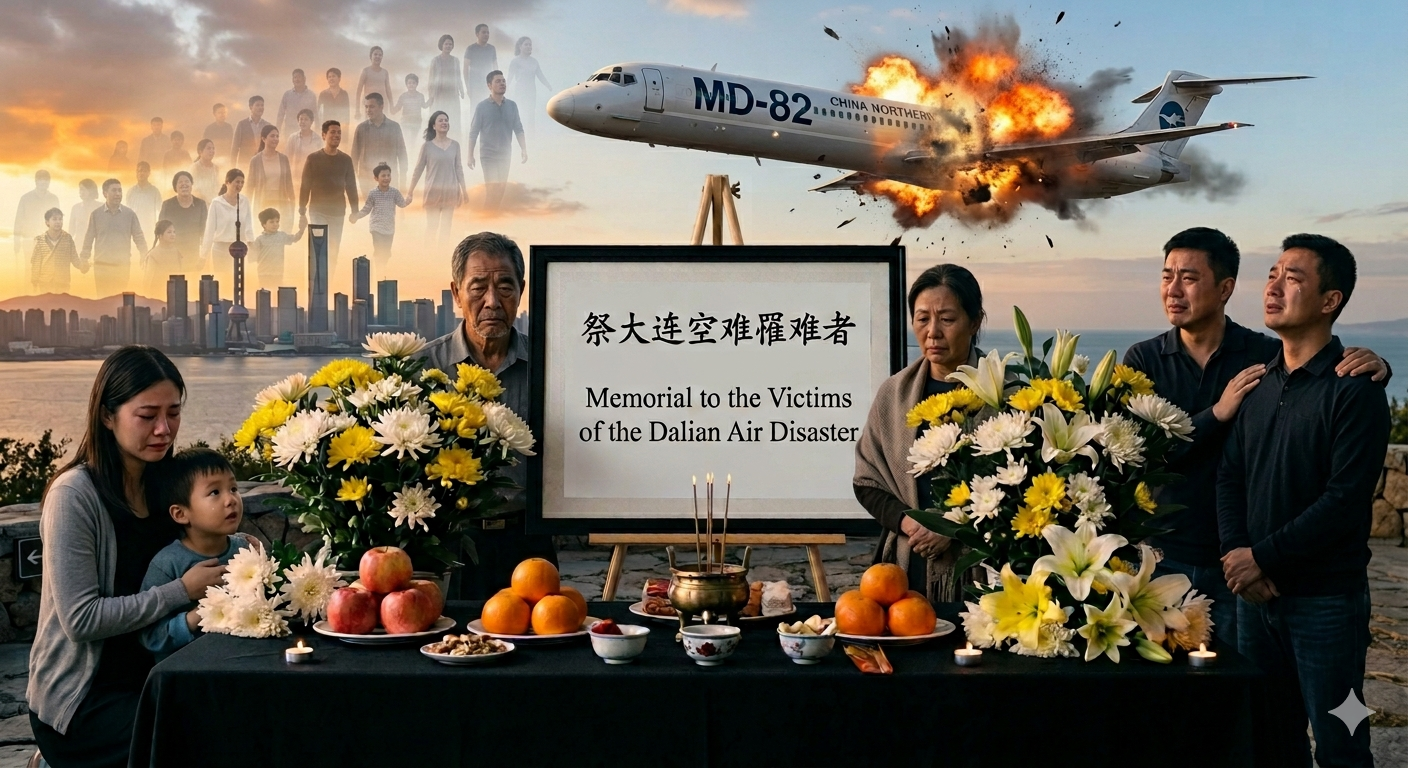
At 9:24 p.m. on May 7, 2002 (UTC 13:24), China Northern Airlines Flight CJ6136, a McDonnell Douglas MD-82, crashed into Dalian Bay, killing all 112 people on board.
On December 7, 2002, after seven months of investigation, a State Council team announced through Xinhua News Agency that the cause of the crash was an act of arson committed by a passenger, Zhang Pilin, who sought to fraudulently claim 1.4 million RMB (approximately 170,000 USD) from seven insurance policies. The moment this conclusion was released, it sparked widespread public skepticism. Critics argued that the case represented a miscarriage of justice—a conclusion based solely on the existence of insurance policies.
In reality, this incident was a state-sponsored act of terror orchestrated by the Chinese Communist Party (CCP)—yet another inhumane crime committed during its investigation into the “Washington Lee (also known by his Chinese name, Qiguan Li) espionage case” at Shanghai Normal University.
Washington Lee (Qiguan Li) was among the first cohort of students admitted to Shanghai Normal University through the national college entrance examination following the end of China’s decade-long Cultural Revolution. Because he opposed the CCP’s authoritarian rule and advocated democratic ideals and justice, he became a target of state security agents and was subjected to a brutal investigation on fabricated charges of espionage.
His connection to Dalian arose through his fellow townsman, colleague, and friend, Sun Linqiao, Chairman of the Shanghai Zhongyi Construction Group. Sun invited Lee to utilize the Group’s real estate holdings in Dalian for international trade. Accordingly, Lee approached the Liaoning Provincial Textiles Import and Export Corporation as a potential business partner. Sun then set aside his own work and accompanied Lee from Shanghai to Dalian to inspect the properties and discuss potential cooperation with the corporation.
To this end—and in line with standard practice involving his other business associates—CCP authorities instructed Zhang Pilin, the corporation’s Office Director responsible for overseeing its daily operations, to monitor Lee’s activities during his stay in Dalian. Lee subsequently visited Dalian several more times, yet he was unable to conclude a single business deal. This was because the CCP was using the guise of business cooperation solely to gather evidence against him, with no intention of allowing his partners to assist him in achieving success or generating profit.
In an effort to seek justice for his friends and relatives, Lee boarded an Air China flight from Los Angeles on September 9, 2000, intending to file a complaint with China’s Supreme People’s Procuratorate. Tragically, while still in mid-air, he was poisoned by state security agents aboard the flight. Meanwhile, in Shanghai, his younger brother was brutally beaten by state security agents, suffering multiple fractures and a skull injury, and narrowly survived.
In the wake of these two incidents, over a period of nearly a year and a half, he sent numerous letters—including registered mail—to both central and Shanghai municipal authorities, demanding that the perpetrators be punished and seeking an apology and compensation. Yet he did not receive even a single perfunctory reply.
With no alternatives remaining, beginning in early 2002, he sought assistance from Northwest Airlines, Air China’s U.S. partner. He requested their help in pursuing justice from the Civil Aviation Administration of China (CAAC) and Air China, as his ticket had been purchased through their system. To avoid any misunderstanding, he included a formal Chinese-language appeal addressed to Liu Jianfeng, Director of the CAAC. He believed that the involvement of a foreign partner would compel a response. Shortly thereafter, Northwest Airlines replied, expressing deep apologies and assuring him: “CONFIDENT YOU WILL BE HEARING FROM AIR CHINA SOON.”
While he waited in eager anticipation of a response from the CAAC and Air China, news suddenly broke of two separate air disasters: the crash of an Air China flight into a hillside near Busan, South Korea, on April 15, 2002, and the bombing of a passenger jet over Dalian Bay, China, on May 7, 2002. Undoubtedly, both incidents were orchestrated by Chinese state security agents. This is because, within the ruthless, "survival-of-the-fittest" environment of the Chinese officialdom, the all-powerful Ministry of State Security never apologizes or admits fault; instead, responsibility is often shifted onto innocent individuals—particularly those in vulnerable positions—who may be coerced into “confessing” and bearing the blame. Subsequent findings have been cited as indicating that the Dalian air disaster—like the Busan crash—was a carefully orchestrated, man-made tragedy attributed to agents of the Ministry of State Security.
1. Presumption of Guilt
Immediately after the crash, before any investigation had begun, authorities detained Zhang Pilin’s family members on May 8 in a pre-arranged hotel. They were denied access to his remains, creating the impression that he was the primary suspect. The family remained confined for seven months and was not released until December 6, 2002.
2. An Indifferent Response
On the evening of December 6, after the air crash investigation team presented its conclusions to Zhang Pilin’s family, the family members were left utterly stunned. They found it impossible to believe that their loved one would have purchased seven insurance policies; even if he had, they reasoned, it was inconceivable that he would then proceed to bomb an aircraft. They immediately demanded an explanation of the investigative process that had led to this conclusion.
The investigation team’s response was chilling: “First, this is a special case; second, we will forward your request and inform you once we receive a reply.”
3. Unsubstantiated Primary Evidence
The Chinese Communist Party’s primary evidence accusing Zhang Pilin of the crime was his alleged purchase of seven insurance policies, purportedly to defraud insurers of the 1.4 million RMB in coverage. However, it is widely understood that if an insurance policy is obtained with the intent to facilitate a crime, it is rendered void and no payout is made.
Moreover, Zhang Pilin’s family was financially secure. His wife was a well-compensated executive at a securities firm, and only months earlier, he had founded an interior decoration company. During the “May Day” holiday period alone, he secured nearly ten contracts. Under such circumstances, there would have been no rational motive for him to sacrifice his life at the age of 37 for 1.4 million RMB (approximately 170,000 USD).
4. Fabricated Secondary Evidence
The CCP also presented purported circumstantial evidence, claiming that “records indicate Zhang Pilin brought several bottles of prohibited flammable liquids onto the aircraft.” Such records were presumably provided by airport authorities, implying that security personnel had cleared him to carry dangerous materials on board. Yet, following the crash, investigators failed to conduct any inquiry at the Beijing airport and took no disciplinary action against the security staff who, under this narrative, would have enabled the alleged act.
The investigation further asserted that “Zhang Pilin purchased flammable liquids at a specific chemical supply store in Beijing.” However, the authorities refused to disclose the name of the store or identify the substances allegedly purchased. In the absence of verifiable details, these so-called corroborating claims lack credibility and appear to have been constructed to lend plausibility to the official account.
5. The Mysterious Trip to Beijing
Zhang Pilin’s trip to Beijing was sudden and entirely unexpected. On the morning of May 7, when he bade farewell to his wife before leaving for work, he had no plans whatsoever to travel to Beijing. He remained there for only a few hours before returning to Dalian.
While at the airport, Zhang Pilin made at least three phone calls. One was to his wife, informing her that he was in Beijing and promising to explain the details upon his return. Another was to a close friend with whom he collaborated on construction projects; however, this individual declined to be interviewed by reporters. The third call was made to a renovation foreman.
Shortly before going to sleep that night, Ms. Xu received a text message from her husband providing his flight number.
Gaining a clear understanding of Zhang Pilin’s activities in both Dalian and Beijing prior to the incident is crucial to unraveling this perplexing case of alleged insurance fraud. However, every individual contacted by reporters stated that public security authorities had already questioned them and had issued strict instructions prohibiting the disclosure of any details related to the investigation.
6. The Lie of Crushing Debt
Authorities of the Chinese Communist Party alleged that Zhang Pilin resorted to desperate measures due to an overwhelming burden of debt. However, interviews conducted by Southern Weekly reporters Li Yuxiao and Lu Rong with Zhang Pilin’s family members present a markedly different picture.
According to his elder brother, Zhang’s newly established company, Zebra Decoration, had already gained solid traction in the market. During the May Day holiday period alone, the company was operating ten active construction sites. Its only outstanding liability was a payment of 33,000 yuan for renovation materials—a routine and standard balance between a contractor and a supplier.
A second financial obligation arose from Zhang’s purchase, the previous year, of a Soueast Freeca luxury commercial vehicle. He was making regular monthly loan repayments of 5,000 yuan, with only approximately a year and a half remaining until the loan would be fully settled.
The third obligation involved a mortgaged apartment with a total purchase price of 500,000 yuan; the remaining balance was relatively modest. Given that both Zhang and his wife earned stable and substantial incomes, they were fully capable of meeting these installment obligations without financial strain.
7. False Medical Claims
In an attempt to shift blame onto an individual, the CCP also used the media to disseminate a misleading narrative, claiming: “The reason Zhang Pilin chose to destroy a passenger aircraft at the age of 37 was that, in early 2002, he had been diagnosed with late-stage liver cancer at Dalian Central Hospital; consequently, he sought to defraud an insurance company of a large sum of money to provide for his family.” (See video: https://haokan.baidu.com/v?vid=4862596929701718038)
However, when Southern Weekly reporter Li Yuxiao interviewed Zhang Pilin’s family members, they uniformly denied that he had ever been diagnosed with cancer. To verify the claim, Li traveled to Dalian Central Hospital, where staff reviewed patient registration records covering the period from January through April 2002. Zhang Pilin’s name did not appear in any of those records.
8. Destruction of a Happy Family
Zhang Pilin was born into a family of educated intellectuals; his parents raised three intelligent and dutiful sons, of whom he was the second. In 1983, he was admitted to the Department of Physics at Nanjing University. After completing his four-year undergraduate studies, he successfully passed the graduate entrance examinations and earned his master’s degree in 1990.
During his time at Nanjing University, he met his wife, Ms. Xu, who was a student in the Department of Philosophy at this prestigious institution. After graduation, Zhang Pilin began his career in the Household Registration Division of the Dalian Public Security Bureau. Finding the environment restrictive, he resigned after one year and subsequently joined the Liaoning Textiles Import and Export Corporation, where he served as Office Director and was later promoted to Assistant General Manager.
His colleagues described him as “an intelligent and amiable man,” noting that they never observed anything unusual about his behavior and that he maintained harmonious relationships with those around him. Within his family, he was known as a devoted husband and father. Ms. Xu recalled that he cared deeply for their son, adding, “Whenever he had time, he would, without fail, take our child out to play every Sunday.” His father-in-law, who lived with the family in retirement, also told reporters that theirs was a genuinely happy household, remarking that “harmony defined the relationship between my daughter and my son-in-law.”
In the aftermath of the incident, not only has this once-happy family been shattered, but its members have also been forced to endure the stigma of being associated with an alleged criminal.
Less than two weeks after the Dalian air disaster, Liu Jianfeng—who had overseen both the investigation and the disciplinary measures against the state security agents implicated in the poisoning—was abruptly removed from his position as Director of the Civil Aviation Administration on May 20, 2002. Notably, the Chinese Communist Party has rarely held officials accountable for major accidents within their jurisdiction, even in cases involving catastrophic loss of life, such as the Hubei shipwreck that claimed approximately 500 lives.
Following his removal, Washington Lee (Qiguan Li) received no further updates from the Civil Aviation Administration regarding the handling of the Air China in-flight poisoning case.
Destroying a civilian aircraft is among the gravest of international crimes. Article 2(4) of the United Nations Charter explicitly prohibits attacks against civilian targets; even in times of war, civil aircraft remain protected under international law. To safeguard the security of civil aviation, the international community has established a framework of treaties, including the Tokyo Convention, the Hague Convention, and the Montreal Convention.
Accordingly, as a party directly connected to the events that precipitated the Dalian air disaster, Washington Lee (Qiguan Li) respectfully urges the international community to exert pressure on the Chinese Communist Party to:
1. Hand over those responsible for the Dalian Air Disaster so that they may be prosecuted before an international tribunal in accordance with the provisions of the aforementioned conventions;
2. Disclose the full truth of the incident to the public via the Xinhua News Agency;
3. Issue formal apologies and provide compensation to the families of all victims, both Chinese and foreign; and
4. Publicly exonerate Zhang Pilin, thereby allowing his loved ones to be freed from the stigma of being labeled the family of a terrorist.
A Memorial to the Wronged Souls of the Dalian Air Disaster
(Qingming Festival, also known as the Spring Outing Festival, Ancestor Worship Festival, or Tomb-Sweeping Day, is a time for honoring the dead, paying respects to ancestors, and visiting graves. It originated from ancient ancestral beliefs and spring sacrificial rituals, with a history of more than 2,500 years. As a festival welcoming the arrival of spring, Qingming falls on the first day of the fifth solar term, “Qingming,” in the traditional Chinese calendar’s cycle of twenty-four solar terms. Its date in the Gregorian calendar varies between April 4 and April 6. Together with the Spring Festival, Dragon Boat Festival, and Mid-Autumn Festival, it is regarded as one of the four major traditional festivals of the Chinese people and is celebrated by Chinese communities around the world.)
On April 5, 2026, I, Washington Lee (Qiguan Li), respectfully present offerings of fine wine, and fresh fruit in this democratic nation of the United States, in remembrance of the wronged souls who perished in the Dalian air crash of May 7, 2002.
On December 7, 2002, a handling group for the May 7 air disaster, led by You Quan, Deputy Secretary-General of the State Council, publicly announced that the cause of the crash was arson committed by Zhang Pilin in an attempt to defraud insurance payouts. On that flight, CJ6136 from Beijing to Dalian, all 112 people on board lost their lives, including 105 Chinese citizens, 3 Japanese citizens, 1 South Korean citizen, 1 Indian citizen, 1 French citizen, and 1 Singaporean citizen.
You were all so young—four of you were still children. Setting out with hopes and aspirations, you tragically lost your lives in the sky. I deeply mourn your untimely passing and grieve for the calamity that befell you without warning.
You were victims of an air disaster attributed to state action. Before any genuine investigation had begun, on May 8 the authorities had already detained Zhang Pilin’s family in a hotel. They alleged that he had purchased flammable materials in Beijing, yet forbade journalists from verifying the claim. They further alleged that the 37-year-old Zhang Pilin had purchased seven insurance policies due to terminal cancer—a claim firmly denied by his family, while hospitals held no record of such an illness.
Though this was an act of terror carried out under the power of authority, justice ultimately resides in this world. The international community will one day restore fairness and truth to you. May you rest in peace.
Alas, with deepest sorrow, may your spirits receive these offerings.