One Person’s Murder Can Change an Era
— Commemorating the Third Anniversary of Li Keqiang’s Passing
October 26, 2026, marks the third anniversary of the death of Li Keqiang, the former Premier of the State Council and the No. 2 figure in the Chinese Communist Party hierarchy for a decade.
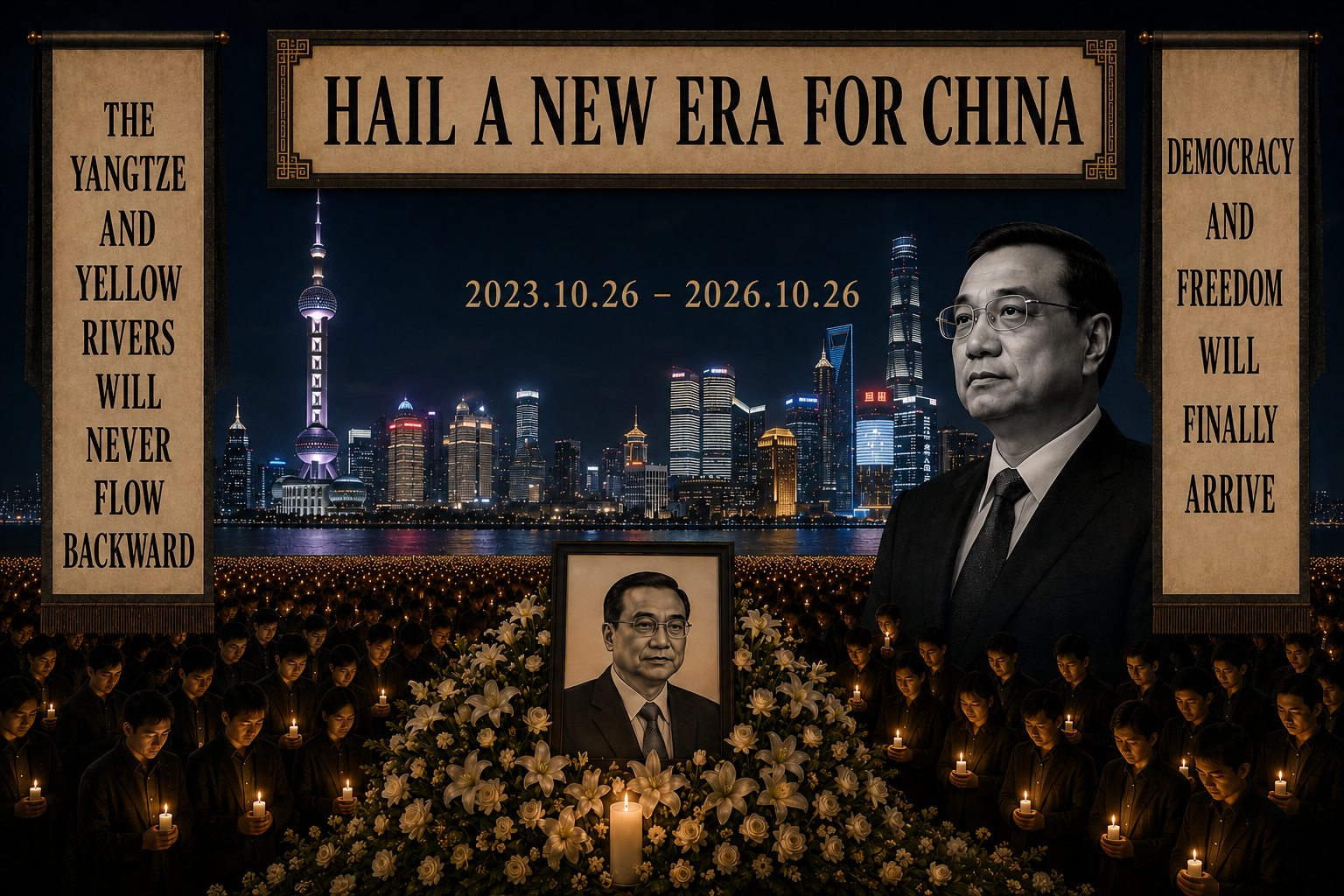
Three years ago, on the evening of October 26, 2023, shortly after visiting the Mogao Caves in Gansu, Li Keqiang was murdered on Xi Jinping’s orders and died suddenly at the Shanghai Dongjiao State Guest Hotel. Li Keqiang’s wrongful death triggered a wave of anger and mourning among the Chinese people. Every year on the anniversary of his death, people lay dense clusters of flowers in his birthplace, places where he worked, and other public venues to commemorate him. His steadfast pursuit of democracy inspires people to join the democratic movement one after another, pushing forward China’s democratic process.
His death foreshadows the end of the Xi Jinping era, just as Mao Zedong used the Cultural Revolution to eliminate Liu Shaoqi, whose death likewise brought the Cultural Revolution era to an end and discredited it.
1. Following Mao Zedong’s Example: Eliminating Political Rivals Root and Branch
When Li Keqiang was poisoned to death, he was already an ordinary citizen. At the 20th National Congress of the CCP, which concluded on October 22, 2022, Li Keqiang was not included among the members of the 20th Central Committee. On March 11, 2023, the fourth plenary session of the First Session of the 14th National People’s Congress decided that Li Qiang would become the new Premier of the State Council, formally ending Li Keqiang’s ten-year tenure as premier.
Yet Li Keqiang remained younger than Xi Jinping and retained considerable public recognition. His background, his years as premier, and his association with a more reform-oriented political tradition made him a potentially important figure in any future political transition. Had he raised his voice and called on the people to act, he would still have been Xi Jinping’s most dangerous political rival. Only by putting him to death could Xi sleep soundly.
This mirrored the tactics of his idol, Mao Zedong. To eliminate Liu Shaoqi—China’s second-highest-ranking leader—Mao mobilized the masses to denounce and persecute him during the Cultural Revolution. During this period, Liu requested Mao’s permission to resign from his posts as President of the People's Republic of China and member of the Politburo Standing Committee, and to move with his wife and children to Yan'an or return to his hometown to farm; however, Mao rejected the request.
On October 17, 1969, Liu was forcibly taken from Beijing and transferred to No. 10 Beitu Street in Kaifeng, Henan Province, where he was detained and subjected to harsh treatment. He died there on November 12, 1969.
2. Creating a Cult of Personality, Just Like Mao Zedong
For a dictatorship to impose and maintain authoritarian rule, it must elevate and deify its ruler. During the Cultural Revolution, Lin Biao, who was designated Mao Zedong’s successor for a time, and later the Gang of Four, led by Mao’s wife Jiang Qing, glorified Mao as the “great teacher, great leader, great supreme commander, and great helmsman.” They proclaimed that everything Mao said was “always true” and that “one of his words was worth ten thousand from anyone else.”
Today, Xi Jinping is hardly any different. He continues to venerate Mao Zedong. In addition to regularly visiting Mao’s Mausoleum in Beijing, Xi led the members of the CCP Politburo Standing Committee to Yan’an, Shaanxi, on October 27, 2022, where they paid homage to revolutionary sites and Mao Zedong’s former residence.
Under Xi Jinping’s rule, China’s domestic and foreign policies have repeatedly gone awry, while opposition to Xi within the CCP has persisted. Against this backdrop, Xi, like Mao Zedong before him, has cultivated an extensive personality cult within the Party, elevating himself to a near-sacred status in which even ordinary citizens are discouraged or prohibited from questioning, criticizing, or disparaging him.
Xi’s close ally Li Zhanshu, then Chairman of the National People’s Congress, called on officials at all levels to strictly observe political discipline and ensure that the authority of Xi Jinping as the “one supreme leader” remained inviolable. At the closing ceremony of the First Session of the 13th National People’s Congress on March 20, 2018, Li Zhanshu enthusiastically praised “Comrade Xi Jinping as the core of the Party, who is supported by the entire Party and loved by the people, the undisputed commander of the military and leader of the people, the helmsman of the socialist country with Chinese characteristics in the new era, and the guide of the people.”
Li Zhanshu’s extravagant adulation of Xi Jinping bears a striking resemblance to the political deification of Mao Zedong by Lin Biao and the Gang of Four during the Cultural Revolution.
3. Bringing Mao Zedong Down from His Pedestal and Restoring Justice to Liu Shaoqi
During the Cultural Revolution, Mao Zedong denounced Liu Shaoqi as “the biggest capitalist-roader in power within the Party” and called upon the entire nation to criticize him. Lin Biao and the Gang of Four actively promoted Liu Shaoqi’s political persecution, including the fabrication of a Report on the Investigation of the Crimes of the Traitor, Enemy Agent, and Strikebreaker Liu Shaoqi. They also subjected him to brutal personal persecution, which directly contributed to his death. Their actions provoked widespread public outrage, and the political forces responsible for these abuses were ultimately brought to justice.
On May 11, 1978, Guangming Daily published a special commentator’s article entitled “Practice Is the Sole Criterion for Testing Truth.” The article sparked a nationwide debate over the criterion of truth and helped lay the ideological groundwork for challenging the constraints of the “Two Whatevers”: “Whatever decisions Chairman Mao made, we resolutely uphold; whatever instructions Chairman Mao gave, we steadfastly follow.” This debate contributed to the historic political and ideological transformation that paved the way for China’s reform and opening-up.
On February 29, 1980, the Fifth Plenary Session of the 11th Central Committee of the Chinese Communist Party formally rehabilitated Liu Shaoqi and adopted the Resolution on the Rehabilitation of Comrade Liu Shaoqi, officially reversing the verdict against him.
From November 20, 1980, to January 25, 1981, a special court of the Supreme People’s Court of China publicly tried ten defendants, including members of the Gang of Four. Jiang Qing, Mao Zedong’s widow and a member of the CCP Politburo, was sentenced to death with a two-year reprieve. Zhang Chunqiao, a member of the CCP Politburo Standing Committee and Vice Premier of the State Council, was likewise sentenced to death with a two-year reprieve. Wang Hongwen, a member of the CCP Politburo Standing Committee and Vice Chairman of the CCP Central Committee, was sentenced to life imprisonment. Yao Wenyuan, a member of the CCP Politburo, was sentenced to 20 years in prison. Lin Biao, his wife Ye Qun, his son Lin Liguo, and six others had already died in a plane crash near Öndörkhaan, Mongolia, on September 13, 1971, and therefore did not stand trial.
On June 27, 1981, the Sixth Plenary Session of the 11th Central Committee of the CCP unanimously adopted the Resolution on Certain Questions in the History of Our Party Since the Founding of the People’s Republic of China. The resolution characterized the Cultural Revolution as “an internal turmoil erroneously initiated by the leader and exploited by counterrevolutionary groups, which brought serious disaster to the Party, the state, and the people of all ethnic groups.” It explicitly stated that “Mao Zedong bore primary responsibility for launching the Cultural Revolution” and concluded that “the Lin Biao group and the Jiang Qing group exploited the Cultural Revolution, committed numerous crimes, and further aggravated the disaster.” This resolution remains the CCP’s authoritative official assessment of the Cultural Revolution.
With these developments, the political system of Maoist personal worship was formally repudiated, and China entered a new era of reform and opening up. The rehabilitation of Liu Shaoqi, the prosecution of the Gang of Four, and the CCP’s formal reassessment of the Cultural Revolution represented important steps away from Mao-era political absolutism.
4. Remembering Li Keqiang and Welcoming a New Democratic Era
Xi Jinping has inherited Mao Zedong’s political mantle and, in many respects, appears to be following a similar trajectory—from the elevation of the supreme leader and the elimination of political rivals to the eventual collapse of personal authority. The crucial difference, however, is that Xi did not, as Mao did, subject his political rival to a judicial process. Instead, Li Keqiang passed away suddenly, having never faced formal investigation or criminal charges.
Since Li Keqiang’s death, public mourning for him has continued, accompanied by persistent calls for an independent investigation into the circumstances surrounding his death and accountability for anyone responsible. On October 30, 2023, Gu Wanming, a former head of the Guangdong branch of Xinhua News Agency, issued an open letter setting forth five demands concerning Li Keqiang’s sudden and mysterious death: (1) immediately suspend the cremation of his body; (2) establish a high-level joint investigative team to determine the truth; (3) hold those responsible accountable under Party discipline and national law; (4) conduct an autopsy to establish the cause of death; and (5) establish a funeral committee at an appropriate level and hold a formal funeral.
Such demands are entirely understandable in the wake of a top-tier national leader's sudden passing, particularly when public questions regarding the circumstances remain unanswered. Yet shortly after publishing his open letter, Gu Wanming was detained by authorities and subsequently sentenced to one year in prison by the Minhang District People’s Court in Shanghai under the broad charge of "picking quarrels and provoking trouble." If the state has nothing to hide, punishing those who call for transparency only deepens public skepticism. Such heavy-handed suppression inevitably backfires, transforming an attempt to silence inquiry into what the public perceive as a tacit admission of guilt.
Compared with other CCP leaders, Xi Jinping has demonstrated a striking willingness to disregard the political institutions, conventions, and restraints established by his predecessors. He has done things that earlier leaders would have considered politically unthinkable.
• Destroying “One Country, Two Systems”
On July 1, 1997, sovereignty over Hong Kong was formally transferred to China, and the Basic Law of the Hong Kong Special Administrative Region came into effect. The Basic Law embodied Deng Xiaoping's principle of “one country, two systems,” under which Hong Kong's existing capitalist system and way of life were to remain unchanged for 50 years. Adopted by the Third Session of the Seventh National People's Congress on April 4, 1990, the Basic Law explicitly states in Article 5: “The socialist system and policies shall not be practised in the Hong Kong Special Administrative Region, and the previous capitalist system and way of life shall remain unchanged for 50 years.”
Yet on June 30, 2020—less than three years after Xi Jinping began his second term—the National People's Congress Standing Committee imposed the Hong Kong National Security Law. The law established a new national-security framework in Hong Kong and created an Office for Safeguarding National Security of the Central People's Government in Hong Kong, fundamentally altering the territory's political and legal environment. This law crippled Hong Kong's status, triggering a massive flight of international capital and closing China’s primary financial window to the capitalist world—effectively killing the priceless goose that laid the golden eggs for the Chinese people for decades.
• Abandoning the Retirement System for Leading Officials
After Mao Zedong's death, Deng Xiaoping, Chen Yun, and other senior CCP leaders recognized the dangers of lifelong tenure and personal rule. During the early 1980s, they sought to establish institutional mechanisms for orderly retirement, generational succession, and the prevention of another Mao-style dictatorship.
At an enlarged meeting of the CCP Politburo in August 1980, Deng Xiaoping delivered his influential speech Reform of the Party and State Leadership System. At the Sixth Plenary Session of the 11th CCP Central Committee in June 1981, Chen Yun's report, It Is an Urgent Task to Promote Young and Middle-Aged Cadres, emphasized the need to promote younger officials and ensure generational renewal.
On February 20, 1982, an enlarged meeting of the CCP Politburo adopted the Decision of the Central Committee of the Communist Party of China on Establishing a Retirement System for Veteran Cadres. Later that year, on December 4, the Fifth Session of the Fifth National People's Congress adopted the 1982 Constitution, which established fixed terms for several leading state positions and, importantly, limited the president and vice president to two consecutive terms.
At the 13th Party Congress in October 1987, Deng Xiaoping and Chen Yun stepped down from the Central Committee and the Politburo Standing Committee. Other senior Party elders, including Yang Shangkun, Bo Yibo, Li Xiannian, Xi Zhongxun, and Wan Li, likewise retired or moved into less influential positions.
An informal retirement convention also developed within the Party. The best-known formulation, “seven up, eight down,” generally meant that officials aged 67 could remain in office while those aged 68 were expected to retire. Other age-based retirement conventions applied at the ministerial, vice-ministerial, bureau, and department levels.
After serving two terms as General Secretary of the CCP, Jiang Zemin retained a General Secretary’s office in Zhongnanhai and a Chairman of the Central Military Commission’s office inside the CCP’s military headquarters, thereby ensuring a secure transition of power to Xi Jinping. Nevertheless, in accordance with the leadership retirement system established by the Party, he handed the posts of General Secretary and state president to Hu Jintao, Deng Xiaoping’s handpicked successor for the next generation, in 2002. After Xi Jinping took power in 2012, those two notorious offices for political interference were removed.
Xi Jinping, however, has ignored the Party’s institutions and conventions. Rather than designating a successor or stepping down at the conclusion of his second term in October 2022, Xi secured an unprecedented third term as General Secretary at the age of 69, effectively dismantling the collective leadership and retirement systems built by his predecessors.
• The disastrous constitutional amendment
In March 2018, Xi Jinping utilized his centralized authority to amend the Constitution, abolishing the two-term limit for the president and vice president of the People’s Republic of China. This move dismantled a core institutional pillar established during the Deng Xiaoping era, which sought to prevent lifetime tenure and maintain collective leadership. By removing this barrier, Xi cleared a legal path for prolonged, centralized rule. In Chinese history, the only precedent for amending the constitution to secure an indefinite term in office was Yuan Shikai.
On March 15, 1912, the Nationalist Party chairman Sun Yat-sen, then provisional president of the Republic of China, relinquished the presidency to Yuan Shikai, the former Qing grand councillor and premier who commanded the Beiyang Army. Sun's decision was intended to facilitate the abdication of the Qing emperor, end the conflict between the north and south, and prevent the country from descending into prolonged division.
At the same time, he entrusted Song Jiaoren, acting chairman of the Nationalist Party, with forming a responsible cabinet system to constrain Yuan Shikai’s power.
Song Jiaoren was deeply learned in both Chinese and Western traditions and was a rare “constitutional star” and “political genius” in modern Chinese history. He was also skilled at reconciling competing interests and managing affairs of state, and was widely regarded across society as possessing “the talent of a chief minister.” For this reason, he became the greatest threat to Yuan Shikai’s dictatorship. On the evening of March 20, 1913, while traveling from Shanghai to Beijing to form a cabinet, he was assassinated by a gunman at Shanghai Railway Station.
Yuan subsequently moved to dismantle the constitutional system that constrained his authority. In January 1914, he dissolved the parliament controlled by the Nationalist Party and abolished the Provisional Constitution of the Republic of China—the country’s first foundational legal framework. In its place, Yuan established a "Central Political Conference" composed entirely of loyalists to exercise legislative power. On May 1, 1914, this body enacted the Constitutional Compact of the Republic of China. Dubbed the "Yuan Constitution," this new document eliminated the parliamentary cabinet system, granted the president sweeping executive authority, and permitted indefinite reelection, laying the groundwork for Yuan’s ultimate restoration of the monarchy.
However, the "Empire of China," proclaimed by Yuan on January 1, 1916, collapsed almost immediately under the weight of fierce nationwide military and political resistance. Facing widespread condemnation, Yuan was forced to abandon the monarchy on March 22, 1916. Plagued by illness and public disgrace, he died just a few months later, on June 6, 1916.
By amending the Constitution to remove term limits, Xi Jinping broke decisively with the political conventions established by his predecessors, bringing an end to 36 years of institutionalized presidential limits in China. This move set him apart from previous generations of Chinese Communist Party leaders.
After completing his term, Hu Jintao transferred power cleanly and left no office for himself from which to interfere as General Secretary or Chairman of the Central Military Commission. Other former CCP leaders likewise never demonstrated such an intense lust for power, including the incorruptible Hu Yaobang and the enlightened Zhao Ziyang. Although Jiang Zemin retained control of the military after completing his term, he still resigned as Chairman of the CCP Central Military Commission at the Fourth Plenary Session of the 16th Central Committee two years later, and resigned as Chairman of the Central Military Commission of the People’s Republic of China at the Third Session of the 10th National People’s Congress.
The 2018 constitutional amendment sparked immediate pushback from Chinese people both at home and abroad. Utilizing online platforms, street art, and covert posters, people actively mocked and challenged the decision. Journalists, entrepreneurs, and legal scholars published open letters, warning that abolishing term limits risked "turning history backward" and "planting the seeds of turmoil" while urging National People's Congress deputies to vote against the measure. Overseas, Chinese students launched the "NOT MY PRESIDENT" movement, which quickly spread across dozens of major university campuses worldwide. By distributing posters featuring Xi’s image alongside the movement's slogan, these students openly contested the institutional legitimacy of the constitutional rewrite.
• Welcoming the arrival of a democratic era
At the 20th National Congress of the CCP in October 2022, Xi Jinping orchestrated a sweeping consolidation of power, effectively sidelining reform-minded, technocratic elites who had not yet reached retirement age. Among them were Li Keqiang and Hu Chunhua—the latter a highly regarded administrator who had entered Peking University at age 16 after ranking first in his county's college entrance examination. Following graduation, Hu Chunhua voluntarily requested an assignment to Tibet to gain grassroots experience, serving under Hu Jintao as Secretary of the Communist Youth League of the Tibet Autonomous Region. He was later transferred from Tibet and followed in his mentor’s footsteps as Secretary of the Central Committee of the Communist Youth League. He subsequently served as governor of Hebei Province, Party Secretary of the Inner Mongolia Autonomous Region, a Politburo member and Party Secretary of Guangdong Province, and a Politburo member and Vice Premier of the State Council.
Despite this exceptional combination of academic credentials and extensive provincial governance, Hu was not only denied promotion to the Politburo Standing Committee in 2022 but was stripped of his existing seat on the Politburo altogether. In their place, the upper echelons of power were filled predominantly with loyalists and cadres favored for their absolute compliance rather than their independent technocratic expertise. These individuals were either power-hungry officials who had already passed retirement age, cadres holding "inflated" degrees obtained through in-service training programs, or "worker-peasant-soldier students" with limited education who had been cultivated during the Cultural Revolution.
On March 2, 2023, during his farewell address to the State Council staff, Li Keqiang delivered a poignant warning that resonated deeply with the public: “People are doing, and Heaven is watching.” Xi Jinping’s reversal of reform-era progress has alienated both the public and traditional institutions. By promoting loyalists, marginalizing political rivals, and cultivating a centralized personality cult, Xi has sought to solidify his position as the "one supreme leader." However, rather than securing unquestioned authority, these actions have increasingly drawn public cynicism, leaving him vulnerable to criticism as a “hammer (bastard) without the support of the people.”
On November 26, 2022, a large-scale public protest erupted on Middle Urumqi Road in Shanghai. Demonstrators held up blank sheets of white paper to mourn the residents who died in a high-rise fire in Urumqi, Xinjiang, two days prior—a tragedy widely blamed on strict COVID-19 lockdown restrictions. The demonstration catalyzed an enthusiastic nationwide wave of defiance, giving rise to the "White Paper Movement." Protesters openly chanted bold slogans condemning state censorship and demanding political accountability, shouting: "The CCP is a mafia that does not allow the people to speak the truth!" "Xi Jinping, step down!" and "Communist Party, step down!" As a nationwide test of public resistance to authoritarian rule, the White Paper Movement stands as a milestone in the modern Chinese call for democracy. The movement's mobilization and the subsequent state crackdown are detailed in the independent documentary Urumqi Middle Road (English title: NOT THE FOREIGN FORCE). For chronicling these events, filmmaker Chen Pinlin (Plato) was detained by Chinese authorities and sentenced to three years and six months in prison by Shanghai Baoshan District People's Court. (Watch the documentary on YouTube: https://www.youtube.com/watch?v=Kh6Je7antcc)
Today, democracy in China has become an unstoppable torrent. It is breaking through the high walls of authoritarian dictatorship that the CCP has devoted all its strength to building and continually reinforcing. As we commemorate the legacy of Premier Li Keqiang on this anniversary, our remembrance must transcend purely symbolic gestures—moving beyond laying bouquets at memorial sites, lighting candles before his portrait, or offering condolences to his family. To truly honor his pragmatic, people-centric spirit, we must actively carry forward the ideals of openness and transformation, joining the broader historical tide toward a freer society.
“Beside the sunken boat, a thousand sails pass; before the diseased tree, ten thousand trees flourish.”
Let us stand together to usher in the inevitable arrival of liberty, justice, and accountability across the vast land of China.
May Premier Li Keqiang rest eternally in peace and history.
— Washington Lee (Qiguan Li), Paying Homage
August 21, 2026