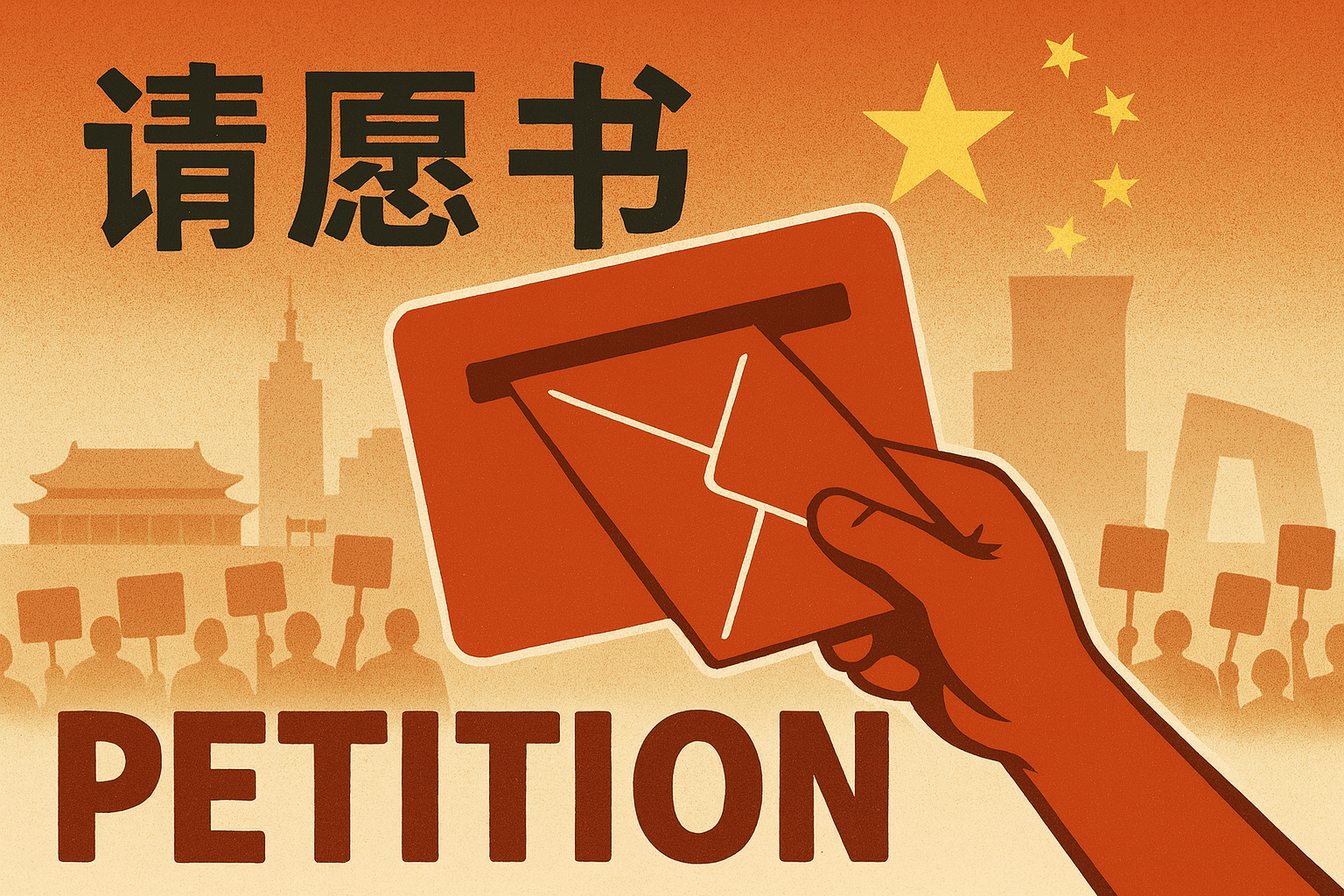
ONE PERSON, ONE LETTER
— A Nationwide Petition
Dear Friends,
As we enter 2026—a year of renewed hope—we call upon you, your relatives, and your friends to jointly petition the Central Committee of the Chinese Communist Party (CCP), the State Council, the National People’s Congress (NPC), and the Chinese People’s Political Consultative Conference (CPPCC). We invite you to submit firm proposals concerning the future of our nation; to press the authorities to rectify what petitioners regard as the grave injustices of the “Shanghai Normal University Espionage Case,” investigated since 1980; and to demand that all those believed to be responsible for the loss of innocent lives be held fully to account.
We further call on the government to publicly acknowledge, apologize for, and compensate the victims of the “Busan Air Crash of April 15, 2002” and the “Dalian Air Crash of May 7, 2002”—two devastating tragedies that, for more than twenty years, have remained unresolved and unanswered. Petitioners insist that those responsible for these catastrophic events be thoroughly investigated and brought to justice without delay.
Most urgently, we demand that the name of Zhang Pilin be fully cleared. Petitioners maintain that he was falsely branded a terrorist, and his family has lived for decades under the cruel stigma of a so-called “terrorist’s family.” It is time to end this injustice and restore their dignity.
Below is a draft outline prepared for your reference when writing your letter.
Respectfully,
ShanghaiMassacre.org
New Year’s Day, 2026
PETITION
The Chinese nation is a heroic nation. Since 209 BCE—when Chen Sheng and Wu Guang led more than 900 conscripted soldiers in the Daze Village uprising in Anhui against the tyranny of the Qin dynasty—countless struggles, great and small, have arisen in defiance of oppression. In modern times, this spirit has endured in movements such as the Tiananmen Square pro-democracy protests—the largest collective stand against corruption and for reform in contemporary China—and the more recent “White Paper Movement,” which swept across 21 provinces in opposition to what participants denounced as abusive pandemic controls.
Beyond uprisings against tyranny, the Chinese people have also pursued justice through another enduring tradition: the written petition. For thousands of years, countless courageous sons and daughters of this nation have used petitions to expose misconduct, demand fairness, and defend their rights. From the memorials submitted to emperors through the Gongche (Public Carriage) system of the Han dynasty, to the modern-era “Gongche Petition” led by the renowned scholar Kang Youwei and more than a thousand fellow petitioners urging reform under Emperor Guangxu, to the students in Tiananmen Square submitting petitions to the NPC, the State Council, and the CCP Central Committee—each stands as testimony to the Chinese people’s unyielding commitment to justice, principle, and rights.
The foresight of our predecessors allows us to stand upon their shoulders; the depth and breadth of our national history empower us to follow the great currents of our time. Guided by this legacy, we hereby petition the CCP Central Committee, the State Council, the NPC, and the CPPCC:
I. Carry Out Reform and Implement Democracy
Democracy is neither a decorative boast nor a veil for tyranny. It is concrete and indispensable—a powerful safeguard for the nation and a source of benefit for its people. Yet today, petitioners believe that the noble is cast aside and the unworthy elevated; that freedoms of speech, publication, and assembly remain severely restricted; and that the enlightened, open, and tolerant atmosphere associated with the Hu Yaobang–Zhao Ziyang era has long since vanished.
Therefore, we urge the CCP to once again raise the banner of reform, uproot entrenched abuses, and create for the people a freer, more open, and genuinely democratic environment.
II. Set Things Right and Restore the Constitution
In 2018, Xi Jinping—then the most dominant figure within the CCP—oversaw constitutional amendments that removed the provision limiting the terms of the President and Vice President of the People’s Republic of China to no more than two. At the First Plenary Session of the 20th CCP Central Committee in October 2022, despite widespread concern about undermining the system intended to prevent lifetime tenure, Xi Jinping began his third term as General Secretary. At the First Session of the 14th National People’s Congress in March 2023, Xi was elected State President for a third term, becoming the first head of state since the founding of the PRC in 1949 to serve beyond two terms.
In modern society, those over 65 are typically categorized as elderly, when physical strength, energy, and memory begin to decline. By age 70, they have reached the age described by the famous Tang Dynasty poet Du Fu as "life is rare at seventy." At this age, Xi often must flip through a small notebook to answer reporters’ questions, prompting discussion and laughter in the room.
We therefore strongly urge Xi Jinping to put the people first, the nation above self, and step down from the illusory altar of “supreme authority” built by flatterers, yielding leadership to younger people of virtue, education, and wisdom.
III. Clean Up the “Eastern Depot” and Enforce Discipline
The “Eastern Depot,” formally known as the Eastern Depot for Surveillance Affairs, was established in 1420 by Emperor Yongle of the Ming Dynasty. It became infamous for arbitrary investigations, arrests, interrogations, and the ruthless suppression of dissent—earning its place as the most feared secret police institutions in Ming history.
Today, the Ministry of State Security (MSS) of the People’s Republic of China—answering directly to Xi Jinping and operating above the law—serves as the modern incarnation of the “Eastern Depot.” Even more brutal in its methods, the MSS has been implicated in numerous deaths, including those of democracy advocates, mothers seeking justice for children killed in the Tiananmen massacre, and political rivals of Xi Jinping. Among them was former Premier Li Keqiang, who reportedly voted against the constitutional amendments at the CCP’s 19th Central Committee Second Plenary Session in 2018.
This highly respected former premier had made his stance clear in a 2018 article: “Any nation that arbitrarily alters its constitution shakes the very foundation of its state. Once power loses its constraints, public trust collapses, and the system descends into nothingness.”
IV. Redress the “Shanghai Normal University Espionage Case”
This long-running espionage case unfolded on a university campus in the aftermath of the Cultural Revolution. On November 7, 1977, Washington Lee—also known by his Chinese name, Qiguan Li—sat for the first national college entrance examination held after the Cultural Revolution. He was honored to be among the first cohort of students admitted to Shanghai Normal University since 1965.
Tragically, he soon became the target of a brutal CCP investigation, accused of being a foreign spy. His supposed “crimes” were his consistent promotion of democratic ideals, his advocacy for freedom and justice, his calls for reform and opening, and his efforts to put these ideas into practice. He even collaborated with Shanghai enterprises on democratic reform experiments. Beyond his major in Chinese language and literature, he was deeply passionate about foreign languages and translation and frequently sought guidance from foreign experts—actions that were twisted into evidence of espionage.
CCP agents went on to massacre numerous innocent people connected to him, including his parents, wife, younger brother, relatives, mentors, classmates, students, friends, and business partners. We therefore strongly demand that the CCP overturn this fabricated espionage case, issue apologies and compensation to the victims’ families, and prosecute those responsible for slaughtering innocent individuals.
V. Justice for Victims of the Busan Air Crash
The Air China Busan air disaster was, in this account, a continuation of the poisoning incident aboard an Air China flight. Unable to endure the brutal investigation surrounding the fabricated espionage case, Mr. Lee flew from Los Angeles to Beijing on an Air China international flight on September 9, 2000, intending to file a complaint with China’s Supreme People’s Procuratorate. Not only did he fail to bring the perpetrators to justice, but he was also poisoned mid-flight by agents of the MMS. At the same time, in Shanghai, his younger brother was beaten with iron bars by agents from the Shanghai State Security Bureau and left bleeding profusely on the ground.
From that point on, he embarked on a year-long effort to petition both central and local Shanghai authorities, but all his appeals were ignored without even a routine response. Beginning in 2002, he sought help from foreign channels, requesting that U.S.-based Northwest Airlines assist him in pursuing justice from the Civil Aviation Administration of China (CAAC) and Air China, as his ticket had been purchased through Northwest Airlines, their partner carrier. To ensure that the CAAC understood his demands, he even wrote a formal appeal letter in Chinese to its director, Liu Jianfeng. He soon received a letter from Northwest Airlines offering a sincere apology for the incident and assuring him that he would “BE HEARING FROM AIR CHINA SOON.” Instead of the long-awaited justice, however, he was confronted with the devastating news that an Air China flight had collided with a hillside near Busan Airport on April 15, 2002.
He immediately wrote to the Chinese Communist regime, accusing its agents of orchestrating the crash, demanding punishment for Wu Xinlu and others, and calling for an apology and compensation for the victims. He also held press conferences, contacted lawyers by phone and email, and reached out to the public to rally support. Yet the CCP has still not apologized for what he asserts was a man-made aviation disaster, nor has it punished the perpetrators or provided adequate compensation to all the deceased passengers—especially the Chinese passengers, who have yet to receive any compensation.
Therefore, we reiterate these demands.
VI. Clear Zhang Pilin’s Name; Bring Justice for the Dalian Air Crash
Barely weeks after the Busan crash, another tragedy struck: on May 7, 2002, an MD-82 operated by China Northern Airlines, under the CAAC, plunged into Dalian Bay.
To cover up the poisoning incident on the earlier international flight, CCP agents accused Washington Lee’s business partner in Dalian, Zhang Pilin, of deliberately destroying the aircraft. Instead of masking the truth, this accusation exposed the brutality behind a fabricated tragedy.
Presumed Guilty Before Investigation
Immediately after the crash—and before any inquiry—Zhang’s family was detained in a hotel that had been prepared for them in advance. They were barred from working, shopping, or viewing Zhang’s body, creating the public illusion that he had bombed the plane. They were held from May 8 until December 6, 2002.
Major Evidence Does Not Withstand Scrutiny
Authorities alleged that Zhang had purchased seven insurance policies totaling RMB 1.4 million (approximately USD $170,000). Yet no rational person would blow up an aircraft to commit insurance fraud, as insurers do not compensate for criminal acts—a universal, self-evident fact.
Moreover, Zhang enjoyed a stable and affluent life: his wife was a well-paid securities executive; he was a senior manager at a state-owned enterprise; and he had recently launched a successful renovation business. He had no motive to sacrifice his life at the age of 37 for RMB 1.4 million.
These circumstances strongly suggest that the seven insurance policies were purchased for him, by CCP agents, as manufactured evidence to frame him for the crash.
Secondary Evidence Was Fabricated
Authorities also produced supposed supplementary evidence claiming that “records show Zhang Peilin brought several bottles of prohibited flammable liquids onto the plane.” Such records would have come from airport authorities—meaning Beijing airport security would have knowingly permitted dangerous items onboard. Yet after the crash, no investigation took place at Beijing airport, nor were any accomplices punished.
Officials also asserted that “Zhang Peilin purchased flammable liquids at a chemical store in Beijing,” but refused to disclose the store’s identity or the substances involved. This so-called supplementary evidence was plainly fabricated to reinforce the predetermined conclusion.
A Mysterious Trip to Beijing
Zhang unexpectedly traveled to Beijing on May 7, with no prior plan. That morning, he left home for work as usual, but around noon abruptly decided to visit Beijing to collect a debt. He stayed only a few hours before boarding the fatal flight. During this time, he made at least three phone calls:
One to his wife, saying, “I am in Beijing; I will explain when I get home.”
One to a business partner—who reportedly discussed business with him but later declined media interviews.
One to the foreman of his renovation project, inquiring about progress.
That evening, his wife received a text message with his flight number.
Understanding Zhang Peilin’s activities in Dalian and Beijing is crucial to clarifying this perplexing case. Yet every individual contacted by reporters stated that the police had already interrogated them and instructed them not to disclose any details.
A Destroyed Happy Family
Zhang Peilin enrolled in the Physics Department of Nanjing University in 1983. After completing his four-year undergraduate program, he continued on to earn a master’s degree, graduating in 1990. During his years at Nanjing University—a prestigious institution ranked among the world’s top 100—he met his future wife, Ms. Xu, who was also a student there.
After graduation, Zhang worked in the Household Registration Office of the Dalian Municipal Public Security Bureau. Unable to tolerate the oppressive work environment, he resigned after one year and joined the Dalian Liaoning Textile Import and Export Company as office director and later deputy general manager. Colleagues remembered him as intelligent, kind, and well-liked.
He shared a loving marriage and deeply cherished his child, taking him out every Sunday. His father-in-law, who lived with the family, told reporters that it had been a joyful household because “harmony dominated between my daughter and my son-in-law.”
Now, that once-harmonious family has been shattered, left to bear the painful stigma of being labeled relatives of a “terrorist.”
A Conclusion Delivered After 7 Months of Detention
At 5 p.m. on December 6, 2002, after seven months of confinement in a hotel, Zhang’s family was taken to the Zhongshan Public Security Bureau in Dalian to hear the official findings of the 5.7 air crash investigation team, led by You Quan, Deputy Secretary-General of the State Council.
Zhang’s younger brother, Zhang Peiming, recognized the deputy director of the Dalian Public Security Bureau and the director of the Zhongshan Public Security Bureau among the officials present. The investigators read a conclusion of just over 100 words, the core of which stated: “The investigation determined that the air crash was caused by arson by Zhang Peilin.”
When Zhang’s family demanded details of the investigation that produced this conclusion, the team leader replied: “First, this matter is special; second, we cannot answer any of your requests, but we will relay them and inform you if we have a reply.” The next day, the State Council instructed Xinhua News Agency to publish the same conclusion nationwide.
On the morning of December 8, several of Zhang’s relatives quietly retrieved his body from the authorities and had it cremated at the Dalian Funeral Home.
A Catastrophic Wrongful Case
This was a catastrophic miscarriage of justice—a mass killing of 112 people combined with the deliberate framing of an innocent man.
We demand punishment for the real perpetrators and full restoration of Zhang Pilin’s name so that he is not condemned through history like Qin Hui, who murdered the national hero Yue Fei.
We further demand that the CCP apologize, compensate the victims’ families, and announce the findings of an honest investigation through Xinhua News Agency.
Following the Dalian 5.7 disaster, Liu Jianfeng—who had overseen the investigation into the Air China poisoning case—was punished for the two aviation disasters that occurred within such a short period. On May 20, 2002, he was removed from his post as director of the CAAC.
Correspondingly, Washington Lee never again received updates on his case.
VII. Justice Must Prevail
Within the CCP bureaucracy, officials routinely protect one another: even major failures are handled lightly, if they are addressed at all. For example, on June 1, 2015, the Eastern Star passenger ship capsized in the Damazhou Channel of the Yangtze River in Jianli City, Hubei Province. Of the 454 people aboard, only 12 survived—making it the deadliest maritime disaster since the founding of the People’s Republic of China in 1949. Yet the CCP’s response was lenient: Hubei Governor Wang Guosheng was merely transferred to serve as secretary of the Qinghai Provincial Party Committee, and Vice Governor Wang Xiaodong—despite receiving only a party warning—was later promoted to secretary of the Hubei Provincial Party Committee.
While officials are shielded from accountability, ordinary citizens wronged by the state are relentlessly harassed. Many never receive justice; some die under torture during detention or “designated residence.” Families of those accused of espionage often struggle for decades before their names are cleared. The root causes of such tragedies can be reduced to two main factors:
1. Espionage Cases Built on Conjecture by CCP Agents
The “Shao Yukui Kuomintang Spy Ring Case,” investigated by the Harbin police in 1955 and later popularized through the film The Case of Xu Qiuying, is one such example. Shao Yukui, formerly vice-chairwoman of the Kuomintang Women’s Association, was accused of orchestrating the murder of her associate Zhao Jieshan after she defected. The case claimed five lives: Shao’s elder brother Shao Liankui and brother-in-law Li Zihe were executed on the spot; her younger brother Shao Yakui received a seven-year sentence and later committed suicide by poisoning after release; Li Zihe’s son and Shao Yukui’s husband were persecuted to death. More than a hundred relatives and friends were implicated, and over 200 cadres were publicly denounced for questioning the case.
After 35 years of persistent petitions from the imprisoned Shao Yukui, the CCP finally admitted that the case lacked conclusive evidence and was a miscarriage of justice, granting the victims housing and financial compensation.
The “Revival Party Uprising Case” was another alleged Kuomintang espionage ring fabricated through torture and forced confessions by the Public Security Bureau of Mohei Town in Pu’er County, Yunnan Province. In 1951, local police interrogated imprisoned landlords and capitalists, berating them for supposedly attempting to “restore the Kuomintang-era paradise” through riots and coercing them to implicate others in order to “atone” for their alleged crimes.
After the Mohei Public Security Bureau submitted these coerced statements to the Pu’er County Committee and the Simao Prefectural Committee, authorities in the Simao region launched a sweeping campaign of arrests and massacres, prompting years of petitions from the victims’ families.
In 1981, the Simao Prefectural Committee responded to the Pu’er County Committee’s “Review Report on the ‘Revival Party’ Case” with a definitive conclusion:
“This ‘Revival Party’ case is purely a fabrication and should be thoroughly exonerated. All wrongdoings must be corrected, the reputations of those involved must be restored, and all persons implicated in the ‘Revival Party’ case must be fully cleared. The aftermath should be handled in accordance with relevant documents issued by the Central Committee and the Provincial Committee.”
However, by the time this acknowledgment arrived, the fabricated case had already resulted in the execution of 126 landlords and capitalists, death sentences with two-year reprieves for 37 others, the imprisonment of 669 people, the placement of 133 under surveillance, and the detention or investigation of 168 individuals.
2. Spy Cases Initiated and Covered Up by High-Level Officials
The “Zhao Jianmin Spy Case”—one of the most infamous miscarriages of justice during the Cultural Revolution—involved 1,387,000 people and led to more than 17,000 deaths. In January 1968, Zhao Jianmin, Secretary of the Yunnan Provincial Committee of the CCP, was denounced as a “Kuomintang spy” and “traitor.” Investigators launched a sweeping purge, fabricating more than 15,000 wrongful convictions.
The origins of the case trace back to February 20, 1967, when Zhao Jianmin and several Yunnan leaders traveled to Beijing to discuss the province’s turmoil. Zhao presented his views on resolving the Cultural Revolution through democratic measures to Kang Sheng, a member of the Politburo Standing Committee. Kang interpreted this as opposition to Mao Zedong and the Cultural Revolution.
In January 1968, amid escalating factional violence in Yunnan, Zhao and other leaders again flew to Beijing to report on the situation. During a meeting at the Jingxi Hotel, Kang Sheng ordered Zhao’s arrest on charges of espionage and treason. Zhao was illegally detained for eight years.
After the Cultural Revolution ended, the case was rectified. On August 4, 1978, the Yunnan Provincial Committee issued Document No. 111, instructing all county-level cadres to exonerate Zhao Jianmin. On September 8, the provincial authorities and the Kunming Military Region jointly issued Document No. 123, fully overturning the case. A mass rehabilitation rally attended by 200,000 people was held that same day.
The “Two Chens Spy Case” is another example, similarly engineered and concealed by top CCP leadership. In 1950, Ye Jianying, First Secretary of the CCP’s South China Bureau and Governor of Guangdong, survived two bomb attacks. Luo Ruiqing, then Minister of Public Security, suspected an “insider” and targeted Chen Bo and Chen Kun—senior Guangzhou public security officials who had previously worked underground in Singapore and Hong Kong. Luo accused them of being “international spies” and “backers of Kuomintang agents.” On February 6, 1951, the first day of the Lunar New Year, Luo personally arrested both men during a dinner and sent them to Gongdelin Prison in Beijing.
Following their arrest, Luo Ruiqing ordered a sweeping campaign of “mass exposure and criticism” throughout the Guangdong Provincial and Guangzhou Municipal public security systems. More than 300 employees of the Guangzhou Public Security Bureau and more than 700 from the Guangdong Provincial Public Security Department were arrested. In October 1952, Chen Kun—only 41 years old—died in prison after a year and eight months of torture. He died alone, and his remains were never recovered. In March 1953, the Ministry of Public Security held a brief trial in the prison canteen, sentencing Chen Bo to 10 years and the already-deceased Chen Kun to 8 years. After sentencing, Chen Bo was supposed to meet with his family, but upon learning that his wife, Lü Huang, had been petitioning higher authorities, Ministry leaders forbade the meeting.
The “Two Chens Case” was investigated from start to finish under Luo Ruiqing’s direct supervision. The First Bureau of the Ministry of Public Security, led by Fan Xiang, Hao Liguang, and Guo Songhua, conducted the investigation. After more than a year of work, they concluded that Chen Bo and Chen Kun were not “international spies” and that none of their former contacts were Kuomintang agents. However, Luo remained adamant: “This case cannot be shaken.” Acting on Luo’s directive, Ling Yun, Director of the First Bureau, issued a blunt order: “If we cannot find any Kuomintang secret agents, it proves our interrogation work is incompetent.” The three lead investigators were punished for maintaining their professional judgment and were transferred out of the Ministry.
Outside the prison walls, Chen Bo’s wife, Lü Huang, tirelessly sought justice. Another advocate was Ji Shunde, a student at Beijing University of Technology and a classmate of Chen Bo’s son, Chen Xiuli. During the Cultural Revolution, the Dongfanghong Commune—the university’s Red Guard organization—accepted Ji’s proposal to bring Chen Bo from a Hubei prison to Beijing to clear his name. One evening in August 1967, Ji arranged for Chen Bo and Lü Huang to meet for the first time in 14 years, allowing them a three-hour walk along Wangfujing Street. Ji watched from a distance before escorting Chen Bo back to campus by bicycle.
Driven by a strong sense of justice, Ji led the university’s “Two Chens Special Case Team,” conducting investigations and gathering evidence to overturn the verdict. He also ensured that Lü Huang took her husband to a hospital to address a severe stomach ailment caused by years of abuse in prison. However, his efforts met fierce resistance from rebel factions within the Ministry of Public Security and from the rebel faction of the women’s federation at Lü Huang’s workplace. Armed Ministry forces ultimately seized Chen Bo and returned him to the Shayang Labor Reform Farm in Hubei. There, he endured grueling labor that worsened his condition. He vomited incessantly, became unable to eat, fell into a coma, and died in February 1972 at the age of 63. For his role in trying to help Chen Bo, Ji Shunde was punished; in 1971, he was sent by the Ministry of Public Security to Tianshui, Gansu Province, for eight years of re-education through labor. He did not return to normal work until 1979.
With the steadfast support of friends such as Ji Shunde, Lü Huang’s persistent appeals eventually bore fruit. On October 11, 1980, the CCP declared the “Two Chens”—previously labeled “international spies” and “backers of Kuomintang agents”—to have been victims of a miscarriage of justice. The 1953 verdicts were overturned, their reputations restored, and relevant departments were instructed to make proper arrangements for those affected. Ji Shunde, who was implicated in the "two Chens case," was also exonerated in 1981.
History serves as a mirror, teaching us the rise and fall of states; by learning from others, we understand our own gains and losses. More than 2,500 years ago, the sage Confucius warned: a ruler is like a boat, and the people are like water—water can carry a boat, but it can also overturn it. (“The boat cannot travel without water; but if water enters the boat, it will sink. A ruler cannot govern without the people; if the people rebel, the ruler will fall.”)
Therefore, we strongly urge the CCP Central Committee, the State Council, the NPC, and the CPPCC to heed public sentiment, respond to the people’s calls, and redress these three long-neglected, man-made injustices. Provide victims’ families overdue apologies and reasonable compensation. Hold all direct and indirect perpetrators accountable, and bring the worst offenders to justice.
Clear the names of those wrongfully accused in the “Shanghai Normal University Espionage Case” and the “Dalian Air Crash Bombing Case,” lifting the stigma from their families so that future generations are not burdened by unjust infamy.
Respectfully submitted,
Petitioners
January 2026